Posts

Humanity is violent. Why single out Pirates?
Image
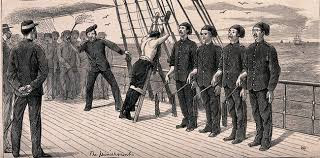
Pirates are not unique in their use of violence. They are often are viewed as the villain in the story, but the truth is everyone is the villain. The wealthy, the noble, the holy, the politicians were all using violence, torture, brutality to force their will. They were all humans who hurt other humans. Sometimes joining as one force in a hateful, homicidal cause. The human race has a savage history. From the crusades and Spanish Inquisition to Colonialism, Privateering, tribal wars and sexual abuse by the afore mentioned groups, our species has demonstrated ruthlessness across class, race, religion, and age. Until recent history people have not been going to therapy nor restraining their impulses and communicating their feelings. Studies show those raised in violent environments or who are abused perpetuate a standard of violence. While this is true in childhood abuse cases it is also relevant if a whole society is living in danger and experiencing trauma as a component ...
Set sail with Cailico Jack

Image
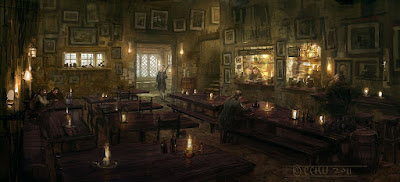
Starring at my reflection in the pub looking glass, I am disappointed to recognize myself.  Although the handkerchief hides the feminine curve of my neck and my late father’s seaman jacket conceals my chest, my face is smooth and my voice high. I may not be mistaken for Blackbeard, but I’ll pass as a prepubescent powder monkey. My swayed walk and act were enough to fool the pirate at the bar into offering an apprenticeship. Hopefully in the sober daylight he’ll still be convinced. It didn’t take much, just a dash of amazement at his most recent mediocre accomplishment, a bit of flattery, and an earnest offering of my service. My being recently orphaned also tugs at the heart strings. Jack Rackman stumbles into my shoulder and pulls me out of my thoughts. With a bottle of rum in hand he gathers his crew, which now includes me. On the way back to the boat   I survey my new shipmates. Twelve or so men, most aged with sun-worn skin. Some stern and brawny men jostle...

Sir Henry Morgan

Image
Henry Morgan, born around 1635 to a Welsh farmer, is one of the most widely known 17 th century pirates. His notoriety could be partially credited to the widely published literary works of Alexandre Exquemellin, a barber/ surgeon aboard his ships. However, few pirates would have made as capturing subject as Henry Morgan. Time and time again Morgan gives us the thrilling story of a triumphant underdog, evading the more heavily armed Spanish using his wit, problem solving mind, and level headedness. Morgan’s career as a privateer in the Caribbean affected not only the image of pirates in literature but influenced the historical development of the Americas as a commissioned English captain working against Spanish reign. Following in the footsteps of his two uncles, Major General Sir Thomas Morgan and Colonel Edward Morgan, Henry left school to become a soldier. According to Coordingly in his text, Under the Black Flag , he joined a military expedition to the New World “whic...

Plundering the Treasure Ports

Image
Christopher Columbus’s voyage to the Spanish Main, a region rich in not only mosquitoes but gold, silver, and precious gems, exceeded European expectations of the New World. This stretch of the American coast located around the southern rim of the Caribbean Sea quickly became the focal source of wealth for Spain, thus a hotbed for piracy and raids. The potential for wealth was astronomical even by today’s standards. In just four years “between 1596 and 1600, Spain imported treasures from the new world worth 34,428,500 pesos… the equivalent of $774 million… in today’s terms” (Cordingly, David). Pesos, also known as "pieces of eight", were the most widely known currency coming from the New World. Officially known as "eight reales", these silver coins were "valued in England at four shillings and sixpence in 1664...the equivalent of $23 today" (Cordingly, David). The valuable natural resources were located inland. After mining the precious m...

Christopher Columbus Hero or Villain?

Image
American public school teaches that Christopher Columbus and other “explorers” were benevolent “discoverers”, sailing the seas on behalf of their sovereigns, in search of knowledge and resources. As a young students we learned cute rhymes like, “In 1492 Columbus sailed the ocean blue”.   Around Thanksgiving half our class donned tea stained fringed frocks and feather headbands and the other half buckled hats and loafers. We sat at the lunchroom table simulating the peaceful breaking of bread and cooperation between the indigenous people and European colonizers. While it is historically accurate that the settlers of Plymouth Rock celebrated the successful harvest of 1621 with members of the Wampanoag tribe, it is untrue that the “explorers” of the Americas treated the native peoples or their land with respect. Explorers invaded land, stole resources such as precious metals and jewels, massacred entire indigenous populations, and sold millions more into slavery. T...

This Week on Myth Busters

Image
When I hear the word “pirate”, my mind immediately conjures an image of a middle-age bearded man drunkenly hobbling around on a peg leg as a pet parrot squawks, perched atop his shoulder. This stereotype has been repeated so often in literature and media you can almost smell the stale sailor stench and hear the gravelly voice bellow, “Arr shiver me timbers”. Unlike a fictional representation like Jack Sparrow, pirates of the Golden Age spoke with the lingo professional mariners.   Although a few aspects of this image are anchored in small grains of truth, the reality of pirate life greatly differs from the picture portrayed by centuries of books, plays, and eventually cinema. Robert Louis Stevenson’s Treasure Island , originally published in Young Folks magazine in 1881 and later in 1883 as a book, forever shaped the way the world views pirates. The protagonist pirate captain, Long John Silver, sails the seas with his pet parrot, Captain Flint. It is a myth that pirates trav...

Common Myths

Like many children in the last century, the Disney movie Peter Pan introduced me to pirates. I sat beside my little sister, unaware of the popcorn I was losing into the couch, mesmerized by a dauntless boy taking on the villainous Captain Hook, the vengeful but educated leader of the Jolly Roger pirate ship.  Hook attended Elton College prior to acquiring his sea legs. Although "a common feature of many pirate films... is the portrayal of the pirate captain as an aristocrat, or as an educated man of some standing in society", (Cordingly, David) most pirates were not of aristocracy. They were more likely to be criminals, former members of the Royal Navy, or merchant seamen who surrendered to the pirates who captured them (Cordingly, David). Dressed in a long red coat, leather buckle shoes, and an ostentatious feathered hat, Hook did not look the part of a weathered mariner. Pirates of this time often wore " short blue jackets, over a checked shirt, and ... long ca...